Navigating Coppola’s Maze: Editing in The Godfather
By Sarah Rivka
A film is written thrice — in pre-production through screenwriting, in production through shooting, and in post-production through editing. Francis Ford Coppola’s The Godfather was written (and re-written) in the editing room by a total of six editors, only two of whom, William Reynolds and Peter Zinner, were credited. Coppola’s biggest struggle, edit-wise, was to reduce the film to a length that Paramount Studios could stomach.
According to Harlan Lebo in The Godfather Legacy, “By the time principal photography was completed, Coppola had shot 500,000 feet of potentially usable footage, or more than ninety hours of material.” Coppola repeatedly removed and replaced scenes, often to “appease the studio,” resulting in the edit becoming a “maze,” with multiple scenes sliced and abandoned on the cutting room floor. (Lebo 188) The work was an epic exercise in reduction that won Reynolds and Zinner a nomination for the 1973 Academy Award in Editing.
The essence of cinema is editing. It’s the combination of what can be extraordinary images of people during emotional moments, or images in a general sense, put together in a kind of alchemy.
— Francis Ford Coppola
Completing their labyrinthine edit, Coppola and his team managed to create contrasting rhythms that amplified violent scenes. Through its varying rhythmic tools—from continuous action to hard cuts and cross dissolves—The Godfather lulls the audience into submission in order to intensify the impact of violent action when it arrives. The rhythm of the film’s editing thereby mirrors the rhythm of the Corleone family, which strives to maintain an equilibrium but often resorts to violence in order to reach it.
***
Rather than employ a non-linear editing style where time is out of order (as famously done in Orson Welles’s Citizen Kane and Quentin Tarantino’s Pulp Fiction), The Godfather is edited in continuous action, with scenes passing in chronological order from start to finish. Coppola’s use of continuous action helps create his lulling ambiance. As we sit in scenes for long periods of time—scenes in which no violence occurs—we fall into the balance of the Corleone family carrying out business. Rhythmically, the majority of the film exhibits this slow, brooding pace.
Within said rhythm, one editing tool that Reynolds and Zinner employ is the transitional cross dissolve. A cross dissolve is the overlapping of two images in either two different scenes or the same scene. In contrast to hard cuts, where there is no visual overlap, cross dissolves are a way to slow down action, creating a gradual and therefore comforting effect.
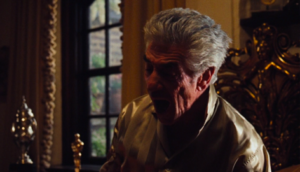
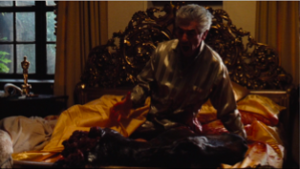
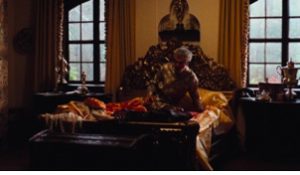
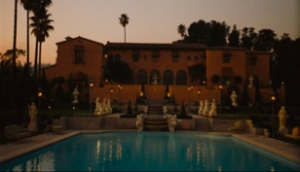
This lulling and brooding ambiance causes the dispersed moments of violence to feel increasingly terrifying. When those moments of violence arise, both the film and viewer are bombarded by a rush of adrenaline. In the gruesome scene of Woltz finding his prized horse’s severed head at the foot of his bed, for instance, we open with multiple cross dissolves over exterior shots of his home, sprinkled with the sound of morning crickets. This establishes an idyllic morning before the horror. Similar to other parts of the film, it is a calm before a storm.
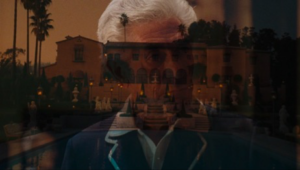
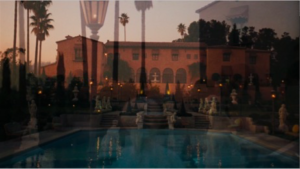
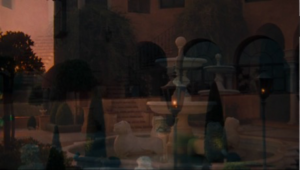
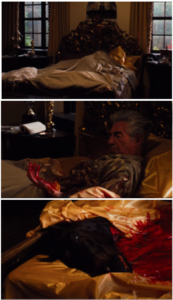
After the idyllic California cross-dissolve setup, the horse’s head is revealed through a long take. Jazz trumpeter Miles Davis has suggested, famously, that “[m]usic is the space between the notes. It’s not the notes you play; it’s the notes you don’t play,” and a similar principle applies to the language of film. A lack of cuts is often more powerful than countless dramatic splices. Had Reynolds and Zinner employed quick cuts here, the horrific reveal of Woltz’s severed horse’s head would read as a modern-day slasher film, which Coppola specifically aimed to avoid so that The Godfather would not fall “[t]oo much into the Corman Horror film tradition.” (Coppola, The Godfather Notebook)
The long take of Woltz waking up, discovering blood, and finding the horse’s head, all within the same shot, creates a sickening feeling that the audience can’t escape. We are forced to experience pain in real-time with Woltz. There are a couple of rhythmic beats resting on the head, making it all that much more terrifying and visceral. The shot holds on the horse’s head for the first two beats of Woltz’s scream, exacerbating the visceral nature of the horse’s killing. We do not cut until after two screams.
While Woltz screams, we visually cut farther and farther back to static shots, amplifying his sense of loss and powerlessness in this predicament. In contrast to the idyllic cross dissolves of exterior shots at the opening of this scene, these hard cuts at the scene’s finish intensify the sense of discomfort.
***
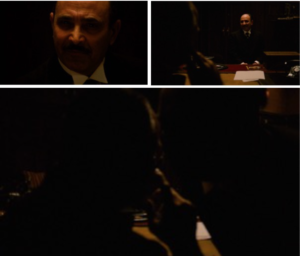
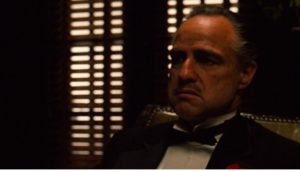
Two scenes that further underscore the potential of a long take without edit are Bonasera’s opening monologue and Connie’s confrontation with her husband Carlo. In the opening monologue, we fade in and there is no hard cut, or any cut for that matter, for four minutes. The first hard cut of the film is when Marlon Brando’s character of Vito is revealed. Because this is The Godfather’s primary cut, it signifies his prominence as a character.
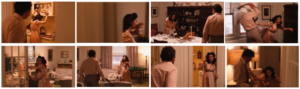
The scene in which Connie struggles to confront Carlo also showcases the power of allowing a long take to play without editing. We follow her from the kitchen, to the dining room, to the parlor, back to the kitchen and into the hallway with the knife—and all without any cut. There is no edit until after she is holding the knife; at that moment we cut to her going in the bedroom. Just as when we experienced Woltz finding his horse’s head, we are stuck in real time with Connie, vicariously trapped in her pain. This scarcity of edits also allows the actors to fully actualize their performance, further intensifying the audience’s experience.
***
No scene in The Godfather is more famous, editing-wise, than the baptism scene—the film’s bravura climax. This scene utilizes the editing technique known as cross-cutting, or parallel editing. In parallel editing, two or more scenes are woven together. These two scenes may be occurring simultaneously or happening at various times, in a montage manner. While it is likely that the baptism and murders occur within a similar time frame, the sense that the film may be breaking, for the first time, from its continuous action underlines this scene’s importance.
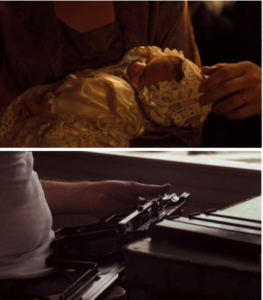
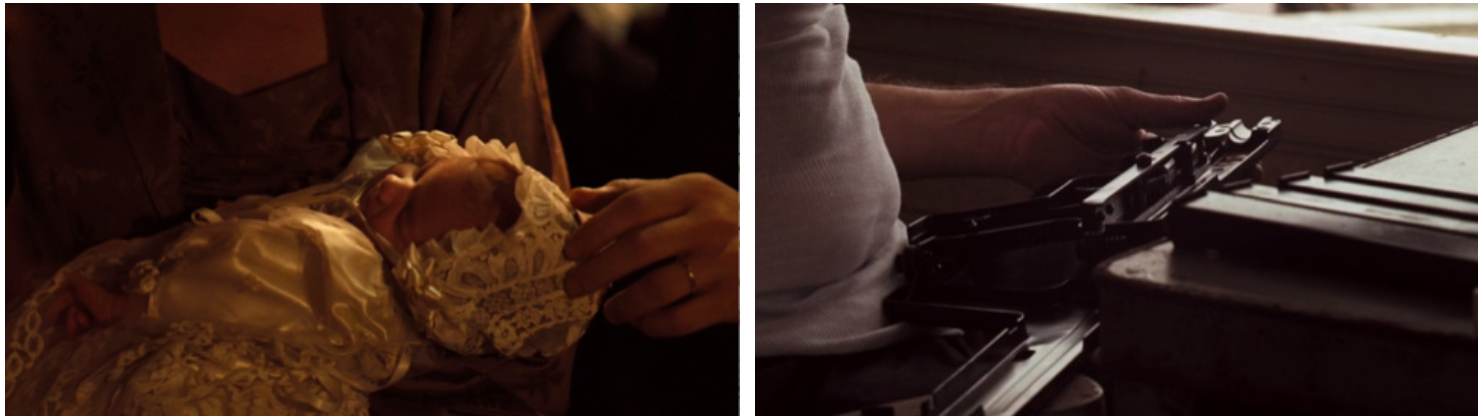
The use of parallel editing allows for stark juxtapositions—sharp contrasts in tone, and often in concept. Michael is becoming a godfather in two senses—to his niece, and to his mafia family. We open in the church, far away and cutting closer and closer in to Connie’s baby (played by Coppola’s now director-daughter Sofia). The first cut we see dramatizing this contrast takes us from the hands of Michael and Kay, holding Connie’s baby, to the hands of another adult, holding a gun. This is the first juxtaposition where the audience can draw parallels between the two worlds in which Michael vows himself to live. Had Reynolds and Zinner edited these as separate scenes, not back-and-forth, the audience would not have the same thematic guide from the filmmakers.
We cut from the gun’s preparation to Michael, whose composure illusrtates how he ruminates, coldly, on the imminent deaths. The baby meanwhile has gone from crying to a state of calmness; there’s a slow in the editing and a pause—another calm before the storm. As the organ builds, Michael says “I do” to renouncing Satan, his sins, and becoming godfather, of baby and mafia. The parallel pre-killing cuts quickly together and the baby is once again wailing, furthering the emotional impact. As seen below, the first parallel cut where he renounces Satan is followed by a murder.
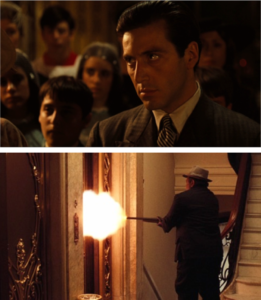
We then cut back to Michael, who says “I do renounce him.” Afterwards, we are pulled into another murder. Along with the organ soundtrack, this cross-cutting creates a rhythm that punctuates each murderous beat. Between each of the following murders, there is at least one cut back to Michael, suggesting his responsibility for the action carried out in his family’s name.
***
In their maze of an edit, Coppola, Reynolds, and Zinner crafted a film of varying rhythmic qualities, allowing it to return to an equilibrium after moments of high tension and violence. The film’s lulling rhythm is reflective of the balance that Michael Corleone struggles to achieve for his family. In his mafia world, these moments of violence are inevitable—and he often succumbs. Rather than editing these scenes into ones that glorify horror, Reynolds and Zinner made them cogent and visceral. The Corleone family, we sense, is stuck in a labyrinth of their own making, perpetually attempting to restore stability and without an exit in sight.
Sarah Rivka (Cal ’19) is a junior majoring in Linguistics with a minor in Creative Writing. She recently returned to school after traveling and working as a freelance video editor. Outside of class, she spends time at UC Berkeley’s radio station DJing soul, jazz, rocksteady, highlife, poems, pop, and more under the moniker Feel Good Weird.
Works Cited
Francis Ford Coppola, The Godfather Notebook (New York: Regan Arts, 2016).
Harlan Lebo, The Godfather Legacy (New York: Simon and Schuster, 1997).
You might be interested in
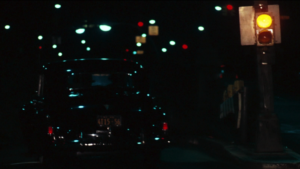 The transition to the scene establishes an atmosphere of tension. Two unidentified men drive Michael into the city to meet Kay at the hotel. The camera jump-cuts from a shot of Michael in the backseat to the car’s bumper. We watch the car pass a flashing yellow streetlight on its right side. It is nighttime, the road is clear, and the only sound effects we hear are the tires hissing against the asphalt. This shot lasts only twelve seconds but establishes a sequence and tone. The direct sound of the tires seems menacing and heightens the peril of events so far—Vito Corleone’s attack, Paulie Gatto’s assassination.
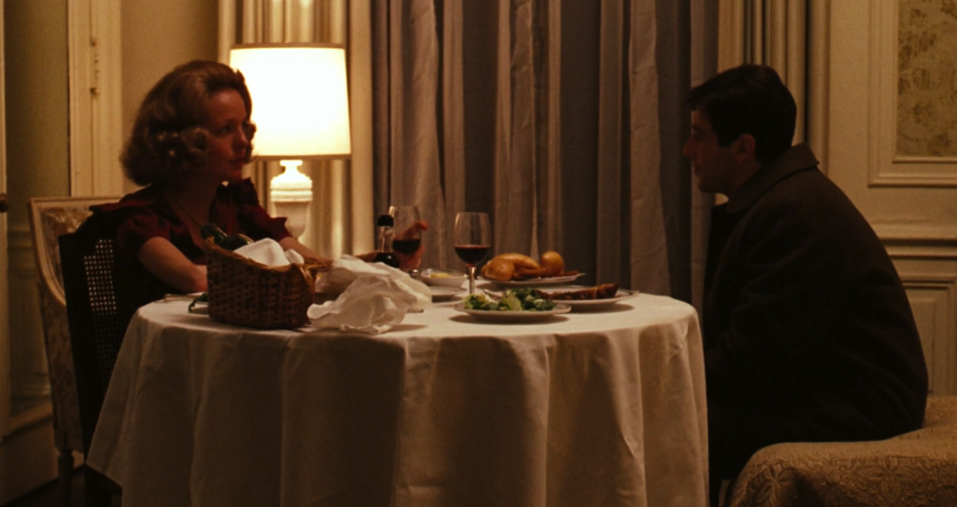
 A slow dissolve transitions us into the hotel room and is joined with a sound bridge, Irving Berlin’s “All My Life.” This song—a slow-tempo ballad often performed by a female vocalist addressing her lover—presents a surprising counterpoint to the preceding events, easing us into the scene and suggesting an emotional uplift in the narrative. It overlaps with the dialogue and is part of the film’s diegesis: the song seems to play somewhere in the background. The music is muted and subtle, softly complementing the dinner’s romantic atmosphere—a small round table and white tablecloth; red wine and steak; Kay’s lipstick-red blouse with a sweetheart neckline and puffed sleeves, Michael’s oxford shirt and tie. A lamp in the corner provides diffused light that illuminates Kay’s face. Her cheeks look cherubic; her skin, soft and warm.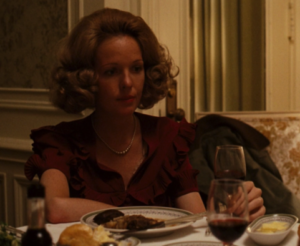
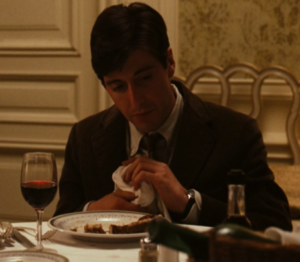 The halting rhythm of the camera draws out the scene’s feeling of awkwardness. The scene’s establishing shot shows Kay sitting at the dinner table. The camera frames her using a point-of-view vantage and positions us in a medium close-up. Immediately we notice her red blouse, princess-length pearl necklace, coiffed hair, and hesitant face. Kay appears vulnerable, and since that vulnerability charges the establishing shot, we know it will inform the scene. The camera transitions to Michael wadding his napkin, looking down and avoiding eye contact with Kay.
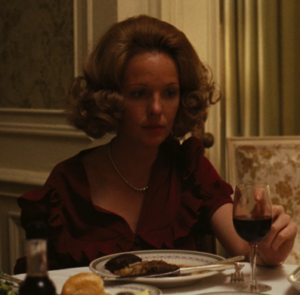 We end with a shot of Kay staring at her wine glass. The camera once again positions us at a medium close-up, reinforcing her pain and hesitation. We know Sollozzo’s attack has unnerved Michael. We might foresee his looming retaliation. Perhaps we even correctly infer his ultimate fate from these character developments. But empathizing with Kay’s pain, we question if her relationship with Michael will last.